If you’ve ever bought a standard coin capsule at a local shop and tried to snap a Spanish cob inside it, you already know the problem. A cob — short for macuquina, the Spanish term for hand-struck coins produced in colonial mints from the 1500s through the early 1700s — is not round. It’s a roughly cut chunk of gold or silver, hammered between dies that rarely landed perfectly centered. The result looks more like a gold nugget with a ghostly cross and shield stamped into it than anything resembling a modern coin. Standard capsules are sized for round coins: they measure diameter in millimeters and assume the coin fills the space evenly. A cob does not. Put a large cob in the wrong capsule and you face a binary disaster: either the capsule won’t close (crushing a high point) or the coin rattles loose inside like a marble in a coffee can, getting hairline scratches every time you move it. This guide gives you the practical framework to size capsules correctly — and explains why the stakes are higher than they look.
Why Cob Geometry Makes Standard Sizing Charts Useless
Round-coin capsule sizing is simple: measure the coin’s diameter, add 0.5–1 mm of clearance, buy that capsule. The NGC Coin storage resource page and PCGS’s Coin Care and Handling guide both describe this approach for standard coinage, and it works perfectly for Morgan dollars, modern commemoratives, and milled Spanish pieces (the machined, round coins produced after roughly 1732).
Cobs break every assumption in that model. Here’s why:
Cobs have two dimensions that matter independently. The first is the maximum span — the widest measurement across the piece, point to point. The second is the maximum thickness — the tallest point, usually a raised high point on the die strike or a natural irregularity in the planchet (the blank disk of metal before striking). A cob might measure 28 mm across its widest span but only 18 mm across its narrowest. A round capsule sized to 28 mm will leave a 10 mm gap on the narrow axis, allowing the coin to tilt and slide. Meanwhile, that same cob might have a high point that stands 4.5 mm tall — well above the interior depth of a standard 2 mm-deep capsule tray.
The weight denomination misleads newer collectors. An 8 escudo gold cob (the largest and most valuable denomination, roughly the size of a large modern coin when it’s well-struck) does not reliably fit in a capsule designed for a U.S. silver dollar or a modern 8-escudo milled piece. Sedwick Coins auction lot descriptions across their 2023–2025 sales consistently note that cob dimensions vary so significantly within a single denomination that two 8 escudo pieces from the same mint, same assayer, and same year can differ by 8–10 mm in their maximum span. This is not a defect — it’s the nature of hand production. But it means there is no single “8 escudo capsule” that works universally.
The Right Measurement Protocol: Three Numbers, Not One
Before you order a single capsule, take these three measurements with a digital caliper (accurate to 0.1 mm):
-
Maximum span (A): The longest measurement across any axis. Hold the caliper flat and rotate the coin until you find the absolute widest point. Record this.
-
Minimum span (B): The shortest measurement across any axis. This tells you how much lateral float the coin will have inside a round capsule.
-
Maximum relief height (C): Stand the coin upright on a flat surface and measure the tallest point — typically where a high point of the cross or shield die rises above the field. This is the depth your capsule well must accommodate.
By the numbers — typical cob dimensions by denomination (approximate ranges observed in dealer catalogs and auction descriptions):
| Denomination | Max Span Range | Typical Relief Height |
|---|---|---|
| 1 escudo gold cob | 14–19 mm | 1.5–2.5 mm |
| 2 escudo gold cob | 18–24 mm | 2.0–3.5 mm |
| 4 escudo gold cob | 22–30 mm | 2.5–4.0 mm |
| 8 escudo gold cob | 27–42 mm | 3.0–5.5 mm |
These ranges are drawn from observable patterns across Sedwick Coins catalog descriptions and Heritage Auctions lot notes — not a controlled sample, but a realistic working reference.
The decision rule here is: size to your maximum span (A) with 1–2 mm clearance, and verify that the capsule’s interior depth exceeds your maximum relief height (C) by at least 0.5 mm. If either condition fails, the capsule is wrong for that coin.
Capsule Types and Which Ones Work for Irregular Pieces
The American Numismatic Association’s Proper Coin Storage member guide distinguishes between three categories of hard capsule relevant to cob collectors:
Standard snap-lock capsules (round, fixed internal tray): These are the default option sold by every major supplier. They work well for milled escudos (the post-1732 round coins from Lima, Mexico City, and other colonial mints) but are risky for cobs unless the coin’s irregular span happens to stay well inside the capsule’s inner diameter. The fixed tray depth is typically 2.0–2.5 mm — inadequate for any but the most lightly struck cobs. Owners of raw, uncertified cobs consistently report that standard snap-lock capsules either fail to close or allow enough movement to generate fine hairline scratches across the fields (the flat background areas of the coin face) over time.
Direct-fit capsules with foam inserts: A better solution for cobs. These capsules include a foam ring or insert around the coin’s perimeter, which accommodates irregular outlines without allowing lateral movement. The foam compresses slightly to grip the coin’s edge without touching the face. Coin World’s Handling and Housing Your Collection feature notes that foam-ring capsules are standard practice for irregular ancients and early colonial pieces precisely because they decouple the “diameter fit” problem from the “thickness fit” problem. The key tradeoff: foam materials vary in archival quality. Look for capsules specifying inert, non-PVC foam — acid-containing foam will migrate to the coin’s surface over years and leave permanent staining on gold.
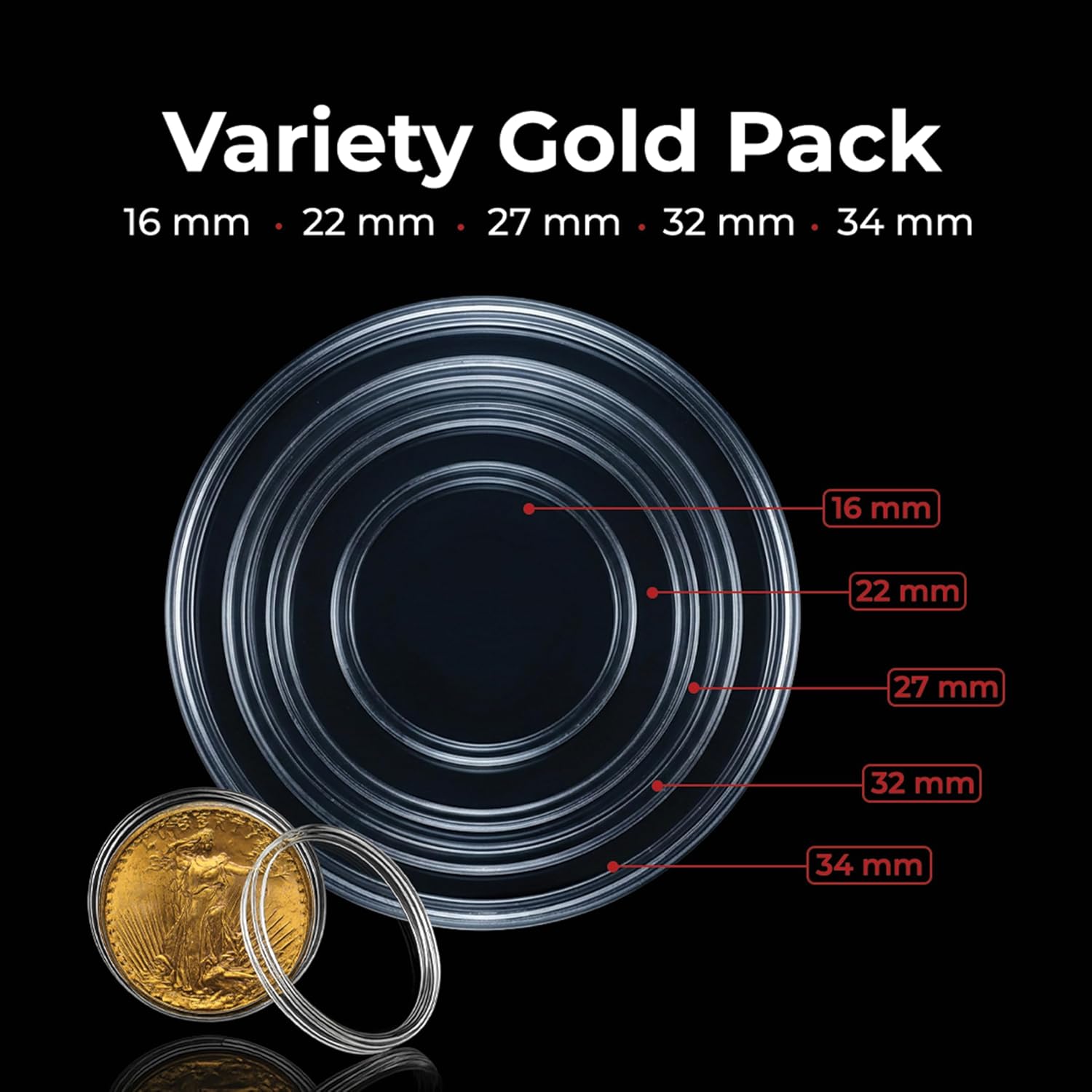
Archival snap-lock capsules with adjustable or deep-well trays: These are the premium option for serious storage. Several suppliers produce capsules with interchangeable inner trays in multiple depth profiles — typically 2.0, 3.0, and 4.5 mm — which means you can match the tray depth to your coin’s actual relief height. Published specs from these product lines show inner diameter options ranging from 16 mm to 46 mm, which covers nearly every cob denomination. For an 8 escudo cob with a relief height of 4.5 mm, a 46 mm inner diameter, 4.5 mm deep-well tray is the correct pairing. These capsules cost more per unit — roughly $3–$8 each versus $0.50–$2 for standard snap-locks — but for a coin worth $5,000 or more, the cost is trivial relative to the preservation stakes.
Certified Coins Are a Different Problem Entirely
If your cob or escudo is already in an NGC or PCGS holder (the hard plastic slabs used by professional grading services), stop — you do not need a capsule. The slab is the archival housing. PCGS’s Coin Care and Handling guide explicitly notes that slabbed coins should be stored in the slab, not removed or supplemented with additional capsule layers. Adding a capsule over a slab creates pressure points and humidity traps.
Where this gets complicated is in the transition period: a coin purchased raw (uncertified) that you intend to submit for grading. The NGC grading submission guidelines note that coins submitted for grading should not be cleaned, and handling between purchase and submission should be minimal — fingertip contact only on the edge, not the face. A correctly sized capsule (foam-insert type, sized to the coin’s actual span and relief) is the right storage solution during this window. It minimizes handling, prevents edge contact with other coins during transport, and does not introduce any conservation chemicals that could affect the grading assessment.
The decision rule: if the coin is raw and going to grading, use a foam-insert capsule sized per your three measurements during transit and storage. Once graded, retire the capsule — the slab is permanent housing.
The Tradeoffs at Each Price Tier
Here is where your decision-frame shifts depending on what you’re protecting:
Under $500 (circulated cob, raw): The standard foam-insert capsule in the right size is correct. Overspending on archival deep-well capsules at this tier is unnecessary. The coin’s value does not justify the premium, and raw coins at this tier are typically held short-term before either resale or submission for grading. Spend $1–$3 per capsule, size correctly, and move on.
$1,000–$15,000 (NGC/PCGS mid-grade milled escudo or certified cob): The coin is in a slab. Capsule question is moot for storage. The only capsule consideration is transit protection before slabbing if you acquired it raw. Use the foam-insert capsule, confirm relief height clearance, submit promptly.
$20,000–$100,000+ (certified shipwreck survivor, royal presentation piece, high-grade rarity): If for any reason you have a coin at this tier in raw form — purchased directly from a private collector or estate, for example — archival deep-well capsule storage is the only acceptable interim solution. The cost of a $6 capsule is irrelevant. What matters is zero lateral movement and zero compression of any high point. Document the coin with calibrated photography before capsule insertion. The estate attorneys and wealth advisors who sometimes handle pieces at this level should treat capsule-related damage to a high-grade surface the same way they treat any conservation error: it is measurable, it reduces value, and it is preventable.
The Clear Decision Rule
If you take nothing else from this article, take this:
- Measure three numbers (max span, min span, relief height) before ordering any capsule.
- Match inner diameter to max span plus 1–2 mm clearance; match tray depth to relief height plus 0.5 mm.
- Use foam-insert capsules for raw cobs — they solve the irregular-shape problem that standard snap-locks cannot.
- Never capsule a slabbed coin — the slab is the housing.
- For transit of any unslabbed piece above $1,000, treat the capsule as a one-time insurance purchase, not a permanent storage solution.
A correctly housed cob costs you five minutes and a few dollars. An incorrectly housed one costs you surface hairlines, compressed high points, and — if the piece was heading to a grading service — a lower grade designation that follows that coin’s certification number permanently.