You’ve spent a year or more tracking down the pieces — maybe a circulated cob 2 escudo from the Lima mint, a mid-grade 8 escudo from Mexico City, a certified shipwreck survivor in an NGC holder. Your collection has crossed $10,000 in value and is climbing. Now comes a question most new collectors defer too long: where do you actually keep these things? Spanish gold coins — whether raw (ungraded, loose) or slabbed (sealed inside a tamper-evident plastic holder by PCGS or NGC, the two major third-party grading services) — are small, dense with value, and quietly vulnerable to risks most people underestimate. This article is a straight-talk guide to home storage options in the $150–$800 price range: what fireproof boxes and gun-cabinet-style lock cases genuinely protect against, what they cannot protect against, and the decision rules that should guide your choice right now.
What “Fireproof” Actually Means — and Where It Stops
The phrase “fireproof box” is on a lot of products at hardware stores and home retailers. It sounds absolute. It isn’t.
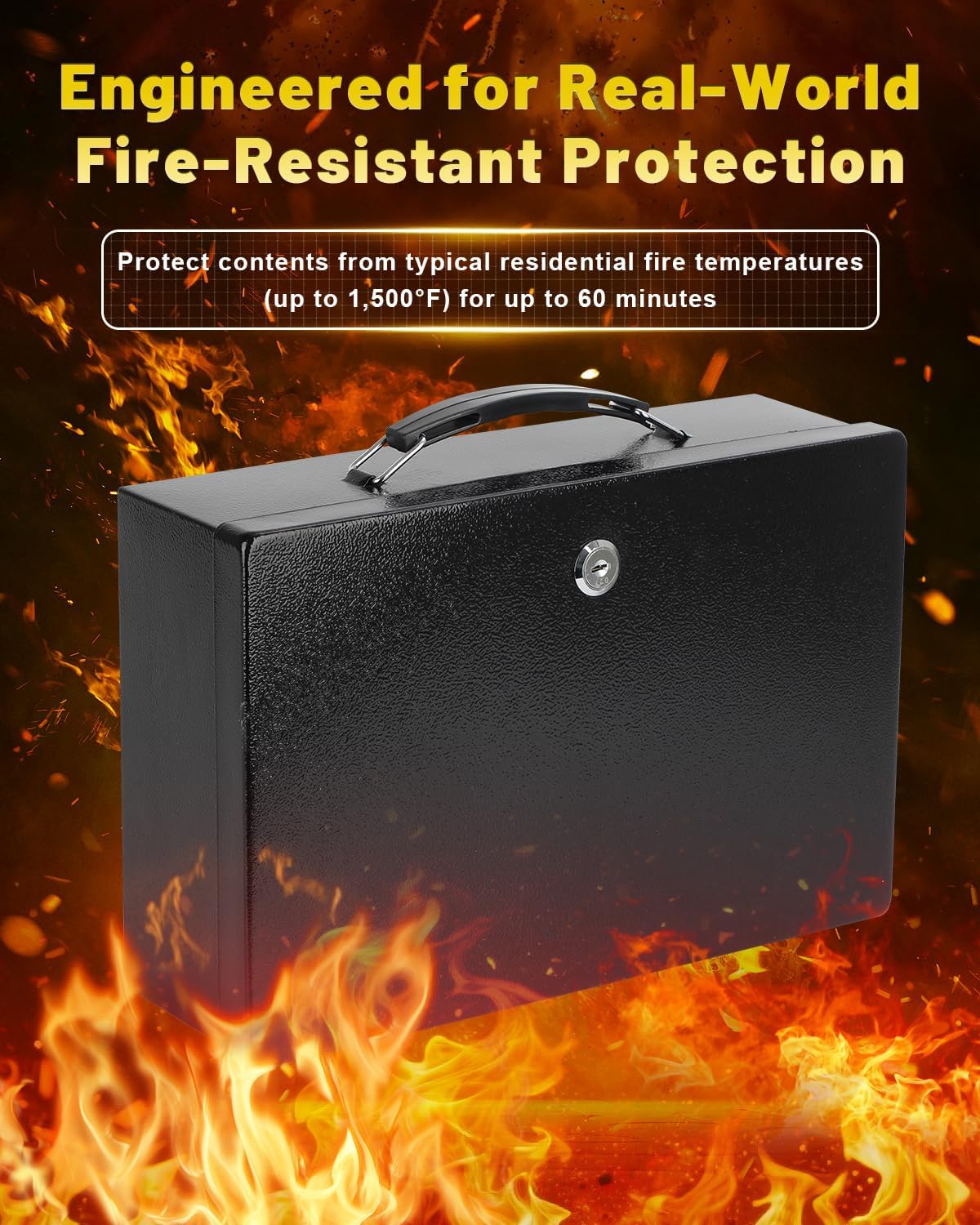
The industry benchmark here is UL 72, the Underwriters Laboratories standard for fire-resistant record protection equipment. A box rated under UL 72 Class 350 is tested to keep its interior below 350°F (177°C) for a specified duration — typically 30 minutes, 1 hour, or 2 hours — while the exterior is exposed to a standardized fire reaching roughly 1,700°F. Why 350°F as the interior threshold? Because that’s the temperature at which paper chars. For paper documents, that rating works well.
Here’s where coin collectors need to pay attention: gold itself melts at 1,948°F, so the metal isn’t your problem. The problem is your NGC or PCGS slabs. Those hard plastic holders — made from various polycarbonate and acrylic formulations — begin to warp and discolor at temperatures well below 350°F. Published materials data and collector accounts documented in Numismatic News suggest significant deformation risk to standard coin holders starting around 250°F–300°F. A UL 72 Class 350 box, performing exactly as rated, could still ruin your slab holders before its internal temperature technically reaches its rated limit — particularly during extended fires or in high-radiant-heat scenarios.
The practical takeaway: a standard consumer fireproof box is better than nothing for slabbed coins, but it is not a preservation guarantee. For raw cobs in flips or 2x2 holders, paper-charring temperatures are actually your floor concern, and those holders may fail first. NGC’s coin care and storage documentation recommends storage in a stable, low-humidity environment; extreme heat events are flagged as a specific concern for holder integrity even when the coins themselves survive.
The second thing fireproof boxes cannot do: stop a determined thief. Consumer-grade fireproof boxes in the $50–$250 range — the rectangular steel units common at hardware stores — are generally rated for fire, not for burglary resistance. Published specs on the most popular units show 16-gauge to 18-gauge steel walls, pry-resistant in the sense that casual tampering is slowed, but removable by any person who can carry 20–40 lbs out a door. If a burglar has ten minutes and a wheeled dolly, a fireproof box is leaving with them.
Lock Cases and Gun Safes: What They Trade Away
Gun safes and purpose-built lock cases occupy the other end of this spectrum. A quality gun safe — think 10-gauge or 12-gauge steel construction, a relocker mechanism, and a pry-resistant door — addresses the theft problem that fireproof boxes ignore. The American Numismatic Association’s collector security guidance specifically identifies anchored, heavy-gauge safes as the baseline recommendation for collections exceeding $5,000 in value.
The tradeoff? Many entry-level and mid-range gun safes carry no UL 72 fire rating, or carry only a 30-minute rating without independent third-party verification. Manufacturers’ self-reported fire ratings on unverified units should be read skeptically — the PCGS storage and preservation guidelines caution collectors against assuming any safe provides fire protection unless it carries a verified third-party rating label.
A second tradeoff is humidity. A sealed, airtight steel safe in a basement or garage can trap moisture, creating a humidity environment that is actively harmful to raw coins. Gold is chemically stable, but the other metals in Spanish colonial alloys — colonial gold coinage was rarely pure, typically running 22 karats with silver and copper admixture — can tarnish and develop surface reactions in sustained high humidity. Slabbed coins are somewhat protected by their sealed holders, but raw cobs in paper flips or cardboard 2x2 holders are directly exposed. NGC’s storage recommendations call for relative humidity in the 40–50% range as a target; gun safes with no desiccant management can push well above that in humid climates.
The fix — silica gel desiccant packs or a small electric dehumidifier rod — is inexpensive and well-documented. Numismatic News coverage of long-term storage consistently recommends installing a rechargeable silica gel canister in any sealed safe. This is a $15–$30 addition that meaningfully changes the humidity equation.
By the Numbers: Storage Option Comparison
| Option | Approx. Cost | Burglary Resistance | Fire Rating | Humidity Control |
|---|---|---|---|---|
| Consumer fireproof box | $80–$250 | Low (portable) | UL 72 Class 350, 30–60 min | None built-in |
| Anchored gun safe, entry-level | $300–$600 | Moderate | Often none or unverified | None built-in |
| UL-listed gun safe, mid-grade | $600–$1,500 | High | UL RSC + UL 72 (look for both) | None built-in; add desiccant |
| Bank safe deposit box | $50–$200/yr | Very high | Bank-vault rated | Stable; no home access |
The Real Decision Frame for a $10,000 Collection
Here’s the question most intermediate collectors ask: Do I need a fireproof box, a real safe, or a bank box? The answer depends on your specific risk profile, not a universal recommendation.
If your collection is primarily slabbed coins (NGC/PCGS holders): Your fire risk is concentrated in slab integrity, not coin metal survival. A UL 72 Class 350 / 1-hour unit is meaningfully better than a 30-minute unit — the extra time matters when fire department response runs 20+ minutes in suburban areas. But burglary is probably a larger statistical risk than house fire for most collectors. If your home has a monitored alarm system, fire risk drops further in relative terms. If it doesn’t, a portable fireproof box is your worst option: it’s both stealable and limited on fire protection above a certain duration.
If your collection includes raw cobs — ungraded, uncertified pieces in flips or capsules: These are more humidity-sensitive and have no slab barrier against atmospheric effects. An anchored safe with a good desiccant system is preferable to a portable fireproof box even if the safe’s fire rating is modest, because you’re adding meaningful theft protection for pieces that can’t be tracked by slab serial number.
If any single piece exceeds $5,000: The PCGS grading and storage guidance, and the ANA’s security materials, both converge on the same point: a collection with individual pieces at this value level warrants either a UL-listed burglary-rated safe (look specifically for the UL RSC — Residential Security Container — rating, which means it passed a standardized attack test) or a hybrid approach where your highest-value pieces go to a bank safe deposit box and everyday-access pieces stay home in a quality safe.
The insurance angle — and why it changes the math entirely: Home contents insurance almost universally caps scheduled coin coverage at $200–$500 without a specific coin rider. A $10,000 collection stored in a box with no standalone policy is effectively uninsured above that cap. The ANA partners with specialty insurers who offer dedicated numismatic coverage; so does Hugh Wood Inc., a firm frequently cited in the coin hobby press. Getting a coin rider — typically 1–2% of appraised value annually — changes the risk calculus on the storage decision: once you’re properly insured, the safe is a complement to insurance, not a substitute for it. Without insurance, your safe is your only backstop. Those are very different decisions.
One more thing fireproof boxes cannot do: they have no serial-number memory. If a slabbed coin is stolen, the NGC or PCGS certification number is your recovery tool — it’s searchable, it can flag the piece at dealers and auction houses, and it’s the reason the coin hobby press has documented stolen-slab recoveries at major auction houses years after a theft. Raw cobs have no equivalent. Photograph every piece — both sides, with a ruler — and store those photos in a cloud backup before you need them.
The Decision Rule
If you take one thing from this article, make it this framework:
-
If your collection is under $5,000, primarily slabbed, and your home has a monitored alarm: A quality UL 72 Class 350 / 1-hour fireproof box, anchored to a stud if possible, plus a coin insurance rider, is a defensible starting position.
-
If your collection is $5,000–$15,000, mix of raw and slabbed, no alarm system: Budget for a UL RSC-rated safe with at least a 30-minute verified fire rating, add a desiccant canister, and get insurance. The safe pays for itself the first time you travel for more than a weekend.
-
If any single piece exceeds $5,000: Put that piece in a bank safe deposit box, period. Home storage for a $30,000 presentation 8 escudo is a risk the math doesn’t support. The annual box fee is the cheapest line item in your collecting budget.
The goal of home storage isn’t to create a perfect solution — it’s to make your collection a harder, slower, more recoverable target than an unprotected one. Fireproof boxes and lock cases can do that. They just can’t do it alone.