You spent real money — maybe $1,200 on a circulated Lima 2 escudo in an NGC holder, or $8,500 on a certified Mexico City 8 escudo milled coin in PCGS MS-62 — and now it sits in a small plastic case called a slab (industry shorthand for the hard, sonically sealed holder that grading services like NGC and PCGS use to encapsulate and grade coins). The slab protects the coin from your fingers and airborne contaminants, and it broadcasts the coin’s certified grade to every future buyer. What it does not protect against is what happens when you put that slab in the wrong box, the wrong drawer, or the wrong environment. PVC off-gassing from cheap holders, microscopic abrasion from foam not designed for plastic cases, and long-term humidity fluctuations can all quietly degrade both the slab and — in worst cases — the coin inside it. This article walks you through the storage decisions that actually matter, with specific tradeoffs called out so you can make the right call for your collection tier and budget right now.
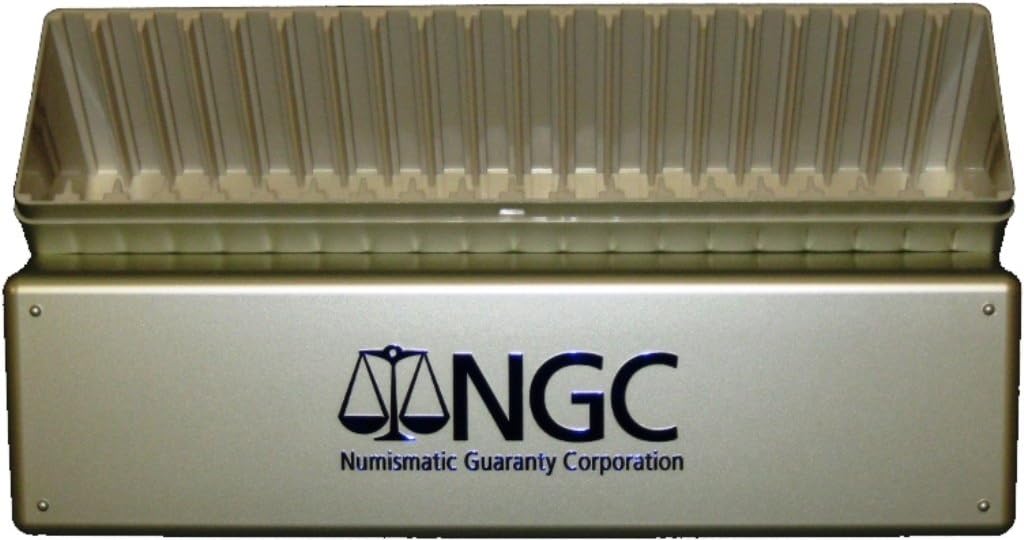
| EDITOR'S PICK[Lighthouse - Coin Box for 50 Sl…](https://www.amazon.com/dp/B00OS6VWXG?tag=greenflower20-20) | Mid-tier[NGC Plastic Storage Box for 20…](https://www.amazon.com/dp/B00JK4SXY2?tag=greenflower20-20) | Budget pick[PCGS Plastic Storage Box for 20…](https://www.amazon.com/dp/B081629HMW?tag=greenflower20-20) | |
|---|---|---|---|
| Max slabs | 50 | 20 | 20 |
| Material | Wood | Plastic | Plastic |
| Finish | Mahogany grain | — | Black |
| Dimensions | 14.625"x6.25"x3.875" | — | — |
| Price | $69.89 | $21.88 | $12.43 |
| See on Amazon → | See on Amazon → | See on Amazon → |
Why Slab Storage Is a Different Problem Than Raw-Coin Storage
Collectors who come up through raw (uncertified) coins already know the basics: no PVC flips, no rubber bands, no cardboard with sulfur-based adhesives. Slabs change the threat model in two important ways.
First, the slab itself is the new vulnerability. NGC holders are made from an inert Surlyn plastic; PCGS uses a similar hard polymer. Both are chemically stable under normal conditions. But they are not immune to physical stress — stacking heavy boxes directly on top of slabs, storing them loose in a drawer so they rattle against each other, or using foam inserts with incompatible off-gassing can cause microscopic surface scratches to the label window. That scratched window doesn’t affect the coin, but it affects perceived grade integrity at resale. A buyer at Heritage Auctions or Stack’s Bowers looking at a $15,000 lot will hesitate if the holder looks abused, even if the coin is pristine inside.
Second, slabs create a false sense of security. The NGC and PCGS holders are sealed, but they are not hermetically airtight. Per NGC’s collector guidance, environmental contaminants can still enter through the label seam over years. Humidity is the primary long-term enemy — not for the gold itself (gold is chemically inert), but for any residual organic material on the coin’s surface and for the integrity of the label printing. A label that fades or shows moisture damage raises provenance questions.
The practical upshot: you need storage that protects the slab from physical abrasion, keeps humidity in a stable range, and allows for organized retrieval without handling individual coins repeatedly.
The Three Storage Tiers — And the Math That Separates Them
Here’s a quick cost-versus-protection comparison for the main storage formats collectors use:
| Format | Approximate Cost | Best For | Key Risk |
|---|---|---|---|
| Standard slab boxes (cardboard + foam) | $5–$15 per box | Entry-level organization | Foam off-gassing; poor humidity control |
| Polypropylene slab boxes (inert plastic) | $15–$35 per box | Mid-range collections | Higher upfront cost; none structural |
| Monitored safe with silica gel | $200–$600+ for safe | $5,000+ holdings | Setup complexity; needs maintenance |
Cardboard slab boxes with foam inserts are the most common starting point. Brands like BCW and Ultra Pro produce these widely. The problem is consistency: not all foam is created equal. The ANA’s educational resources on collection care specifically flag “non-archival foam” as a source of off-gassing sulfur compounds, which, while less destructive to gold than to silver or copper coins, can still affect labels and create aesthetic issues on the slab surface over years. If you’re storing a raw $300 cob, this is a minor concern. If you’re storing a certified $12,000 milled 8 escudo, it is not.
Inert polypropylene slab boxes eliminate the off-gassing concern at the box level. Manufacturers like Guardhouse and Lighthouse produce boxes specifically dimensioned for NGC and PCGS slabs. These are worth the price jump for any piece above $2,000. Numismatic News has noted in its storage guidance that inert plastic containers represent the current best practice for certified coin storage, particularly for holdings that will sit undisturbed for years.
A monitored safe with desiccant packs is the correct answer for any serious collection — not because the safe prevents off-gassing, but because it allows you to control the entire micro-environment around your slabs. A quality fire-rated safe combined with silica gel desiccant packs (monitored with a hygrometer, which is an inexpensive humidity gauge that reads the moisture level inside the safe) keeps relative humidity in the 35–45% range that both PCGS and NGC recommend in their storage guidance. Below 30% RH, label materials can become brittle; above 55%, you risk label degradation and potential micro-condensation on slab interiors during temperature swings.
The Specific Risks for Spanish Gold Slabs
Spanish colonial gold — whether you’re holding a raw cob escudo or a certified Lima 8 escudo milled piece — has one characteristic that makes storage slightly more nuanced than generic numismatics: surface texture variation.
Cob coinage (called “macuquina” in period Spanish, meaning roughly “roughly made” — these are the irregularly shaped, hand-struck coins cut from gold bars before the milled era) has an organic, lumpy surface that can hold microscopic particulate matter in crevices. When a reputable service like NGC certifies a shipwreck cob, they’ve cleaned and stabilized it, but the texture means the slab is often slightly thicker and heavier than a milled coin holder. This weight matters when stacking: a drawer of 20 shipwreck cob slabs weighs more than 20 milled coin slabs, and the downward pressure on the bottom slabs in a poorly designed insert can crack label windows over time.
Practical rule: Never stack more than 8–10 heavy cob slabs vertically in a single column without a rigid separator layer. Polypropylene boxes with individual slot molds, rather than a single foam channel, distribute weight correctly.
For milled 8 escudos — the round, machine-struck coins that replaced cobs after 1732 and represent the high end of the Spanish colonial gold market — the concern shifts to surface contact. These coins have mirror-field surfaces in higher grades, and any holder that presses unevenly against the slab’s transparent window can, over years, create a faint pressure mark visible under certain lighting. This is rare but documented. The PCGS educational library’s coin care guidance recommends storing slabs on their edges (vertically in slots) rather than flat-stacked for exactly this reason — vertical storage distributes pressure to the slab’s edges, not its face.
The Decision Framework: If X, Then Y
You’re making a storage purchase now. Here are the actual decision rules:
If your total certified holdings are under $5,000 in current market value: Use inert polypropylene slab boxes with individual slots (Guardhouse or equivalent). Store in a cool, consistent-temperature interior room — not a garage, not an attic. Add a small silica gel canister to any enclosed shelf or cabinet. Cost: roughly $30–$60 to set this up correctly. This is a meaningful upgrade from cardboard for a modest additional investment.
If your holdings are $5,000–$25,000: Add a dedicated fireproof/burglar-rated safe (a Liberty or American Security unit in the $300–$600 range represents the widely reviewed standard for this tier, per aggregated collector forum discussion and dealer recommendations cited in Numismatic News and Coin World). Place your polypropylene slab boxes inside the safe. Add a calibrated digital hygrometer and maintain 35–45% RH with silica gel packs, refreshing them every 6–12 months. This setup costs $400–$700 total and provides meaningful protection against both environmental and theft risk.
If you hold a single piece worth $20,000 or more — a certified shipwreck 8 escudo, a presentation-quality Lima royal, or a NGC MS-64 milled piece heading to auction — the storage answer is almost certainly a bank safe deposit box for transit periods and a monitored home safe for regular access. The PCGS guidance on coin security specifically recommends safe deposit storage for high-value certified coins when the owner’s home security does not include a monitored alarm system. Per Coin World’s coverage of high-value numismatic theft cases, coins in the $20,000+ range are disproportionately targeted; the storage decision at this level is as much a security decision as a preservation one.
If you are preparing to consign to Heritage Auctions or Stack’s Bowers: Do not rehouse slabs before submission — consignment coordinators at both houses prefer to receive slabs in their original holders so they can assess holder condition independently. Store in individual soft slab sleeves (polyethylene, not PVC) during the period between deciding to consign and shipping, to prevent transit scratching.
What to Avoid — Specifically
The ANA’s collection care resources and PCGS’s storage guidance converge on a short list of definite errors. Worth naming them plainly:
- PVC flips or soft vinyl holders placed against slabs. PVC off-gasses plasticizers that react with coin surfaces over time. Even contact with the outside of a slab can degrade the window clarity over years.
- Rubber bands around stacked slabs. The sulfur in rubber compounds is a slow-acting threat to coin surfaces and label integrity.
- Attic or basement storage without climate control. Temperature swings drive humidity swings; a single winter-to-summer cycle in an unconditioned space can introduce enough humidity variation to begin label degradation.
- Loose storage in a drawer. Slabs sliding against each other produce the micro-abrasions on label windows that subtly reduce a coin’s visual appeal and can complicate resale.
The Bottom Line
The storage investment that’s right for your collection is almost always smaller than collectors assume — but it needs to be the right investment, not just the cheapest one. A $25 polypropylene slab box and a $15 silica gel kit protect a $3,000 coin from the most common failure modes. A $500 safe extends that protection to a collection worth an order of magnitude more. The single most expensive storage mistake isn’t choosing the wrong brand — it’s doing nothing and assuming the slab handles it. It doesn’t. The slab preserves the grade; you preserve the slab.
If you’re sitting on a certified Spanish gold piece right now and it’s in a cardboard box on a shelf, that’s your next decision. The upgrade takes an afternoon and costs less than a dealer’s handling fee on a mid-grade milled escudo.